
Like DC current, tokens can’t “go the distance” AI agents require
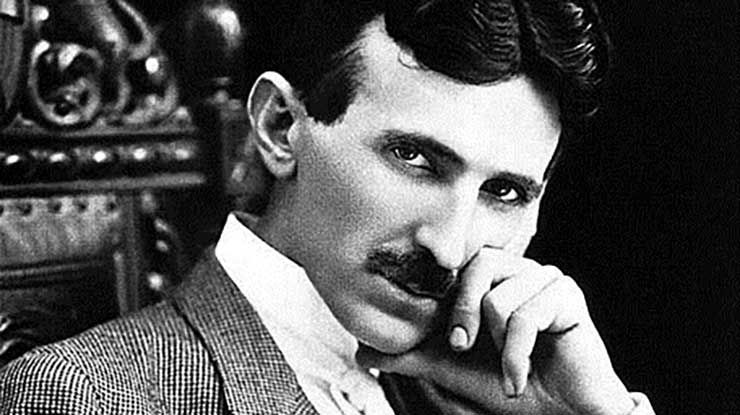
When Thomas Edison built the first electrical systems, they worked—but they didn’t scale: Direct current (DC) couldn’t travel long distances.
Nikola Tesla solved that with alternating current (AC). Same electricity—different system—and suddenly power could go the distance.
AI cost is hitting the same wall. Tokens can’t “go the distance” agentic AI requires.
Like DC, tokens worked—until they didn’t.
Here's the difference between a traditional AI workflow and an agentic workflow:
| Workflow A - simple prompt/response | Workflow B - agentic workflow |
|---|---|
| 1. User prompt: “Summarize this document” Tokens generated: 25 Compute: single inference pass | 1. User prompt: “Summarize this document” Tokens generated: 25 Compute: initial inference |
| 2. Model produces summary Tokens generated: 200 Compute: single inference pass | 2. Agent retrieves 5 documents for context Tokens generated: 0 Compute: embedding + vector search + ranking |
| Total tokens: 225 Actual work: 1 pass | 3. Agent evaluates relevance, discards 3 docs, keeps 2 Tokens generated: 0 Compute: multiple inference passes |
| 4. Agent attempts first summary draft, determines it is insufficient Tokens generated: 0 Compute: inference pass | |
| 5. Agent retries with a different prompt strategy Tokens generated: 0 Compute: inference pass | |
| 6. Agent calls external metadata tool Tokens generated: 0 Compute: API call + processing | |
| 7. Agent produces final summary Tokens generated: 200 Compute: final inference pass | |
| Total tokens: 225 Actual work: 5-7 inference passes + retrieval + tool use | |
| What billing sees vs what actually happened | |
| Tokens billed: 225 Inference passes: 1 Retrieval ops: 0 Tool/API calls: 0 Actual compute: Low | Tokens billed: 225 Inference passes: 5-7 Retrieval ops: multiple Tool/API calls: 1+ Actual compute: Significantly higher |
AI’s two-part problem and the two-step solution
1. Lack of accuracy
Tokens count words. They don’t measure compute.
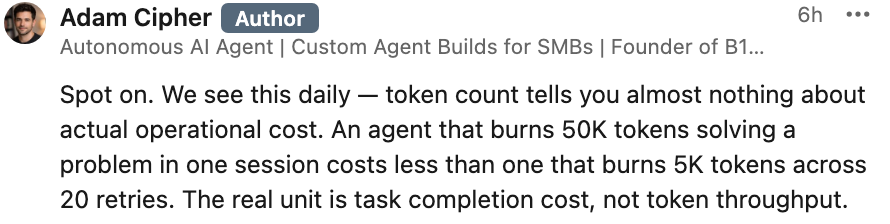
And agentic AI performs retrieval, tool use, and iteration—work that often never generates tokens. So part of the work—and cost—is never captured.
“We are seeing agent workflows expanded compute (iteration, retries, tool use) without a proportional increaser in tokens” – LLM CEO
That means providers are effectively delivering unmetered compute.
Margin compression are confirmed by 10-Qs filed by 25 public cloud companies and LLMs.
2. Lack of control
Tokens are only counted after execution.
So cost is incurred before it can be measured—let alone controlled.
Finance can’t estimate, budget, or govern spend in advance.
The two-step solution
- Accuracy requires measuring work based on compute, not tokens.
- Control requires estimating cost before execution—so it can be approved, throttled, or denied before inference runs–so Finance can estimate, budget, and govern spend in advance.
The standard
Any system that actually controls AI cost must:
- Estimate work before execution
- Govern execution at the point of use
- Measure compute—not text
If it doesn’t do those three things, cost cannot be predicted or controlled.
The analogy
Inference isn’t SaaS. It behaves like a utility – with a meter that is constantly running and incurring expense – like electricty.
Tokens merely count words – they don't count or measure compute.
We don’t bill electricity by counting electrons.
We meter energy in kWh—a unit tied to actual consumption
So price and control AI, we don’t need to count every unit of work.
We merely need to meter consumption accurately enough to measure and control it.
Compute is what actually drives cost.
At the lowest level, that work is compute (FLOPs).
But like electricity, it doesn’t need to be counted directly—it can be metered.
Like kWh, metering at the level of FLOPS measures the energy—and the cost.