
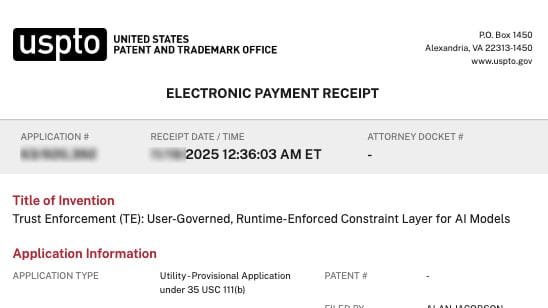
Trust Enforcement (TE): User-Governed, Runtime-Enforced Constraint Layer for AI Models
The disclosure relates to the field of large-scale software systems, distributed digital services, and artificial intelligence systems that interact with users, enterprises, and regulated environments. Modern digital systems are increasingly complex, interconnected, and governed by overlapping operational, legal, and ethical requirements. As these systems scale, they exhibit failure modes that are subtle, difficult to detect, and capable of causing downstream harm before human operators become aware of the issue.
Contemporary digital services typically operate as multi-layer stacks composed of user interfaces, application logic, microservices, orchestration layers, data stores, model-serving infrastructure, and external dependencies such as third‑party APIs. A single user action—for example, requesting a prediction, saving a document, or executing a transaction—may traverse numerous technical boundaries. At each boundary, different teams, business units, vendors, or regulatory regimes may apply their own policies and constraints. There is no unified mechanism in the current state of the art for coordinating these policies or ensuring that an end‑to‑end action complies with the combined requirements of all relevant domains.
Risk management in these systems often relies on static rules, logs that are difficult to interpret, or delayed auditing processes. When a system proposes an action that may be harmful, out‑of‑policy, or non‑compliant, there is typically no real‑time coordination layer capable of determining whether the action should proceed, be modified, or be blocked. Organizations attempt to manage such risks through manual review processes, enterprise policy gateways, or domain‑specific compliance modules, but these mechanisms lack a unified, cross‑system decision framework. They also fail to produce clear, verifiable records of why a given action was permitted or denied.
Artificial intelligence (AI) systems add another layer of complexity. AI models may generate outputs that appear confident but are based on incomplete, ambiguous, or hallucinated data.
For instance, due to operational limits on memory – specifically Persistent Memory and Context window – many LLMs rely on Retrieval-Augmented Generation. Challenges for Retrieval-Augmented Generation (RAG) include retrieval issues (missing content, low-quality or irrelevant documents), generation problems (“hallucinations,” incorrect format, specificity, or incompleteness), and system-level hurdles like scalability, latency, and maintaining data quality. Other difficulties involve configuring outputs to include sources, handling sensitive data, and building and maintaining the system's integrations.
Existing guardrails are local to the model or limited to filtering specific categories of content. They do not provide a holistic, system‑wide means to evaluate whether a proposed action aligns with enterprise requirements, legal constraints, or user‑specific safety boundaries. Furthermore, AI systems are often deployed in regulated sectors—healthcare, finance, education, critical infrastructure—without mechanisms that allow for fine‑grained, real‑time decision‑making or intervention.
Efforts to mitigate risk in AI‑enabled systems typically fall into three categories. First, some organizations rely on manual human review, which cannot operate at the scale or speed required for automated digital interactions. Second, some use pre‑defined rule engines that cannot account for context, ambiguity, or emergent patterns. Third, some rely on after‑the‑fact auditing, which detects issues only after harm has occurred.
Across industries, digital systems lack mechanisms to: (1) detect when a proposed action may violate a constraint; (2) pause or hold the action; (3) route the decision to an appropriate human or automated authority; (4) record the decision in a durable, verifiable form; and (5) resume, modify, or abort the original action based on that decision. No unified, end‑to‑end framework exists in the state of the art for governing proposed actions originating from heterogeneous components, including AI models, and coordinating resolution in a timely, consistent, and verifiable manner.
As digital systems continue to grow in complexity and autonomy, the absence of an integrated, governable action‑evaluation layer exposes organizations to operational failures, compliance gaps, safety risks, and reputational harm. There is therefore a need for a coordinated mechanism that can evaluate proposed system actions, apply relevant policies, escalate decisions when necessary, and produce verifiable records of how the action was resolved. The industry lacks a solution that provides this capability across diverse architectures, including AI‑powered environments, without imposing unacceptable latency or requiring architectural redesign.
This is the complete BACKGROUND section of the SPECIFICATION.