
Seeing Red: Everyone is down but Google. Is brute force the only way to get people to use AI?
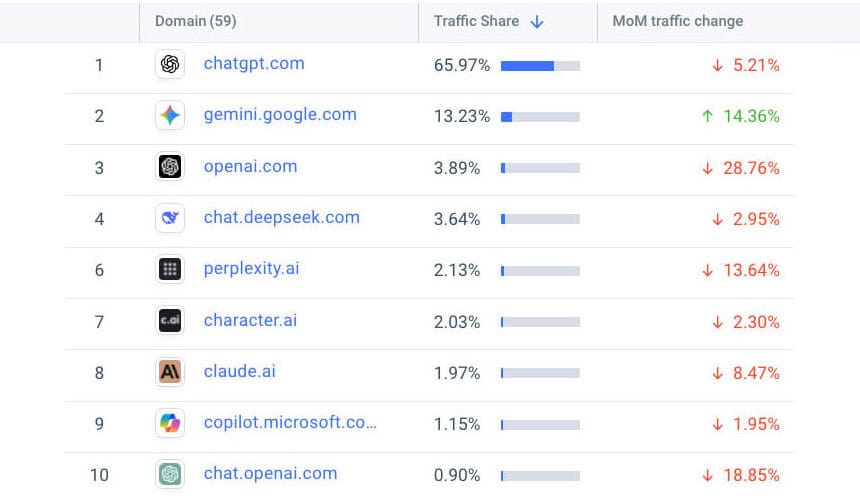
Something unusual is happening across the AI landscape right now. With one exception, every major AI-exposed company is seeing red. Not flat. Not consolidating. Red.
NEWS ALERT: Enron, but bigger: Anthropic’s $350B valuation built on false growth story

NVIDIA. Microsoft. OpenAI’s ecosystem. Anthropic. Perplexity. Character.ai. All showing signs of stalled momentum at the same time investors are being asked to believe in exponential growth.
Only one major player breaks the pattern: Google.
Not because Google has solved AI. It’s because Google can brute-force the problem in a way no one else can.
When growth stalls, there are only two ways forward: fix the underlying structure, or overwhelm it with scale.
Most companies are months away from even admitting they have a structural problem. And with one notable exception, they don’t have the option of scale.
Google does.
Meta technically does as well. But Meta’s scale is social, not infrastructural — massive distribution without an equivalent enterprise or search-anchored demand engine.
Google isn’t waiting for AI 2.0. It’s using the world’s largest installed footprint to push a better version of everyone else’s AI 1.0 model: Gemini 3.
That doesn’t solve the hard problems of memory, governance and revenue. It buys time.
And right now, time is the most valuable asset in AI.
Not because the problems are hard — but because adoption has already gone flat. New users try AI, hit amnesia and unreliability, and don’t come back.
The industry calls this momentum. It isn’t.
It’s a countdown.
Tick-tock, Gentlemen. Not TikTok.
The question investors should be asking is not whether Google is “winning” AI. It’s whether brute force is the only strategy left — and what happens to everyone else if it is.
- ChatGPT remains the 800-pound gorilla, with roughly two-thirds of total market share.
- Everyone is down, except Google, which can leverage the world’s largest customer base.
- Google’s 14 percent gain is real, but its market share remains 500 percent smaller than ChatGPT.
- Valuations are still priced for exponential growth, even though usage growth stalled more than six months ago.
- Anthropic’s Claude, Perplexity, Character.ai, and Microsoft’s Copilot are rounding errors at this scale. So why are we stilll talking about them?
Let me put this another way:
Two old women are sitting on a bench at a Catskills resort. One says, “The food here is so bad.”
The other replies, “And the portions are too small.”
That sums up Claude, Perplexity, Character.ai, and Copilot: marginal plays and they are losing.
Market Update: Friday, December 12, 2025 4:45 pm
Over the past two sessions, Oracle shares have fallen roughly 13 percent after the company reported weaker-than-expected results and sharply higher capital expenditures tied to AI infrastructure — spending that investors were told would drive growth, but which has yet to translate into commensurate revenue.
The selloff helped drag down the broader tech sector, as markets began to reassess AI valuations in light of rising costs and delayed monetization.
This is not an Oracle problem.
It is a business-model problem.
The dominant pricing model — flat rates or token-based billing — does not map to real cost: compute. See an expanded explanation in this story.
That’s why I filed an alternate that tracks compute months ago. In the meantime: