Latest

Trust Enforcement (TE): User-Governed, Runtime-Enforced Constraint Layer for AI Models

Trust Enforcement (TE): User-Governed, Runtime-Enforced Constraint Layer for AI Models

The disclosure relates to the field of large-scale software systems, distributed digital services, and artificial intelligence systems that interact with users, enterprises, and regulated environments. Modern digital systems are increasingly complex, interconnected, and governed by overlapping operational, legal, and ethical requirements. As these systems scale, they exhibit failure modes that

See complete story
Systems and Methods for Comprehensive Trust Integrity in Artificial Intelligence Architectures (TIS)

Systems and Methods for Comprehensive Trust Integrity in Artificial Intelligence Architectures (TIS)

Artificial intelligence (AI) and machine learning (ML) systems are increasingly embedded in critical domains including healthcare, finance, education, employment, law enforcement, national security, social media, and mental health support. These systems are no longer confined to low‑stakes recommendation tasks; they make or shape decisions that can affect liberty, livelihood,

See complete story
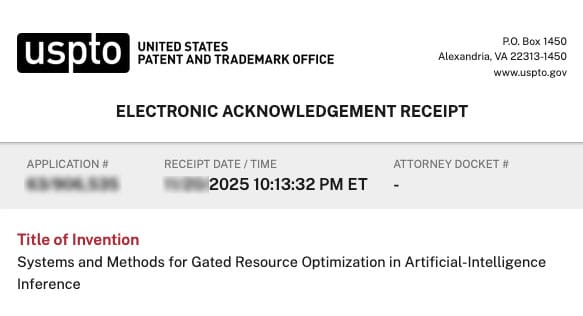
Systems and Methods for Gated Resource Optimization in Artificial-Intelligence Inference

Systems and Methods for Gated Resource Optimization in Artificial-Intelligence Inference

Artificial intelligence systems, including large language models, recommendation engines, vision models, and hybrid multimodal architectures, increasingly operate as general-purpose platforms serving diverse workloads for many different users and organizations. These systems are typically deployed on shared compute infrastructure, such as cloud-based clusters of CPUs, GPUs, and specialized accelerators. As adoption

See complete story
Systems and Methods for Automatic, Loss-Less Data Management of Context Windows and Persistent Memory in AI System

Systems and Methods for Automatic, Loss-Less Data Management of Context Windows and Persistent Memory in AI System

Modern artificial intelligence systems, particularly large language models (LLMs), remain fundamentally constrained by how they manage, retain, and retrieve information across time. Although these systems are capable of producing fluent, context-aware output within a single conversation, their ability to sustain continuity, accuracy, and coherence across extended interactions is limited by

See complete story


Contact us

© 2025 BrassTacksDesign, LLC