
OpenAI to acquire Anthropic for $356B
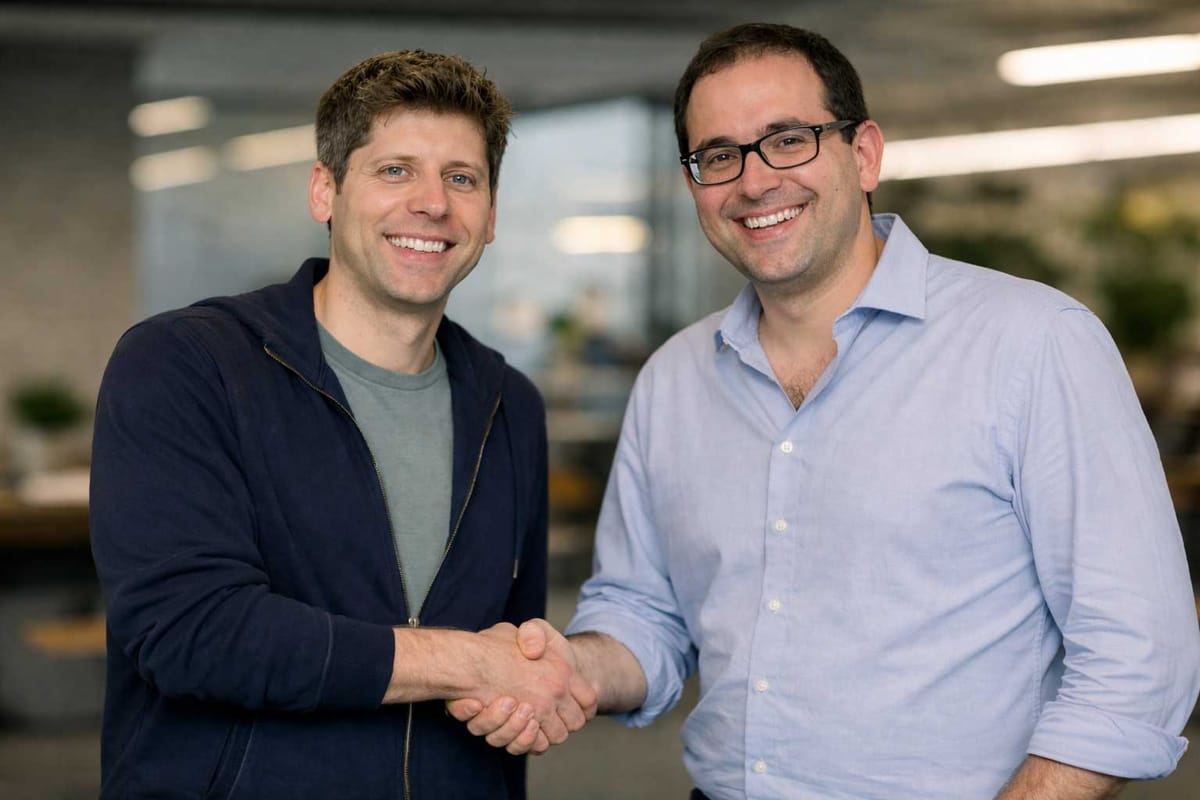
JK. But this outcome is inevitable – it happens when a sector built on narrative collides with accounting reality.
We have seen this movie before
When a market offers little durable differentiation and competes primarily on price, two things happen at once:
- margins collapse
- consolidation accelerates
The Dead and Absorbed
- Airlines: USAir, Continental, Northwest
- Mobile carriers: Sprint, MetroPCS, Alltel
- Memory semiconductors: Qimonda, Elpida Memory, Winbond Electronics
In each case, innovation did not save independence. Scale did.
Which LLM(s) survive?
- ChatGPT (OpenAI)
- Claude (Anthropic)
- Gemini (Google)
- Copilot (Microsoft)
- Apple Intelligence (Apple)
- LLaMA (META)
- Grok (xAI)
- Character.AI
- Perplexity
When it's at race to the bottom on price, only players with balance-sheet resilience, capital access and distribution survive. Everyone else merged, exited or vanished.
AI now exhibits the same structural markers: converging capabilities, customer price sensitivity, rising unit costs, and negative operating leverage. When those forces align, competition does not fragment. It compresses.
The setup everyone is avoiding
The AI market is pricing frontier labs like durable software companies.
They are not.
They are variable-cost infrastructure businesses with rising inference expense, opaque unit economics, and negative operating leverage. That mismatch can persist only as long as growth narratives hold.
They are no longer holding.
Five triggers are converging
1) Mispriced risk
AI is valued as if marginal cost trends toward zero. Inference cost does the opposite. Usage increases expense faster than price. Markets tolerate uncertainty. They do not tolerate systematically mispriced risk once growth slows.
2) Flat adoption surfacing late
Slowing adoption is survivable if disclosed early. Flat adoption, discovered after internal visibility and external silence, is a credibility break. At that point the issue stops being AI and becomes trust.
3) Runaway capex with no commensurate revenue
AI capex is justified as investment, but revenue is not scaling proportionally. Embedded AI turns inference into cost of goods sold. The more “successful” the feature, the more margin it quietly destroys. Markets forgive spending. They do not forgive negative operating leverage.
4) No durable revenue model
Subscriptions don’t track compute cost. Token pricing misprices value. Advertising violates trust and still doesn’t cover expense. There is no third act waiting offstage. Analysts eventually stop asking which model wins and start asking which model makes money. Right now, none do.
5) Hallucinations entering production — the Salesforce moment
This is where theory turned into evidence. What surfaced at Salesforce wasn’t a demo failure. It was hallucinations appearing inside enterprise workflows after AI had been positioned as production-ready. Salesforce sells trust, not novelty. When hallucinations show up there, AI becomes operational risk. Adoption freezes. Deployments slow. Quiet pullbacks begin. The repricing starts.
Why this becomes one market event
Individually, each issue can be rationalized. Together, they force the same conclusion:
- Growth isn’t real.
- Risk was mispriced.
- Spend can’t stop.
- Revenue won’t catch up.
- Trust isn’t improving.
That’s not a correction. It’s a category repricing.
And when that happens, independence stops looking principled and starts looking reckless.
Now the consolidation math
In a crisis, markets don’t ask who is most innovative. They ask who is accountable. Who has a balance sheet. Who can absorb failure.
That’s where the OpenAI–Anthropic framing stops being hypothetical.
All hat, no cattle
Anthropic is all hat, no cattle.
- A headline valuation north of $300B.
- Roughly $11B in actual funding.
- No independent distribution.
- No fallback business.
- No balance-sheet backstop.
Safety rhetoric is not economic durability. A narrative valuation without ballast collapses instantly when conditions turn.
OpenAI, by contrast, is expensive, messy, and margin-hostile — but real. Tens of billions in committed capital. Deep enterprise distribution. A binding partnership with Microsoft that functions as a compute and balance-sheet backstop. OpenAI can survive bad quarters. Anthropic cannot.
That asymmetry decides everything.
Who buys who
Anthropic cannot be the buyer. It lacks excess capital, stable cash flow, and a sponsor willing to overpay in a downturn.
If consolidation is forced, Anthropic is absorbed, merged downward or sidelined. OpenAI survives and dictates terms — not because it’s better, but because it’s solvent.
Any acquisition would be sold publicly as “alignment consolidation.” In reality, it would be survival math.
Alternative buyers like Oracle or Amazon only enter after economics are restructured. None inherit a money furnace willingly.
The point of the headline
The headline is a joke.
The forces behind it aren’t.
Salesforce was the warning shot. When the AI market reprices risk, consolidation won’t feel dramatic. It will feel overdue.
And the surprising part won’t be that OpenAI acquires Anthropic.
It will be that anyone thought this industry could stay fragmented once the numbers stopped lying.