
Is Sam toast?
He survived a firing, Then a leaked memo. Now he faces Wall Street.
Once is an anomaly. Twice is a warning. Three times is a pattern.
Sam Altman has now entered his Act Three.
Act I: The ouster
In November 2023, Altman was abruptly fired by his own board. No warning. No clear explanation. Just a statement about “candor” and a CEO suddenly out.
The episode shattered the myth of stability at the center of the AI boom. Whatever OpenAI was, it was not a settled institution. Governance was improvised. Power was opaque. Trust was brittle.
Altman was reinstated days later after employee revolt and partner pressure, but the damage lingered. Boards do not fire founders casually. When they do, it signals something deeply broken behind the curtain.
That was strike one.
Related stories
Sam Altman is Donald Trump
Microsoft’s Mistake
Act II: The leaked memo
News broke on a Saturday.
Not a press release. Not a keynote. An internal warning that leaked into public view — and landed with a thud felt far beyond San Francisco and Redmond.
Sam Altman told staff to brace themselves. Competition was intensifying. Google’s Gemini 3 was coming. And the near-term outlook, in his own words, was not great.
“I expect the vibes out there to be rough for a bit.”
That line mattered more than any technical detail.
CEOs do not talk about “vibes” unless they are already feeling pressure — from markets, from partners, from inside the building. This was not optimism. It was expectation management.
The substance of the memo reinforced the tone. Costs were rising. Revenue remained uncertain. The company’s dependence on Microsoft was no longer a background fact but a structural reality. Internally, the tension between moving fast and staying safe had not resolved — it had hardened.
The real problem was not that the memo was candid. It was that it existed at all, and that it leaked.
At the exact moment OpenAI needed to project confidence — to enterprise buyers making long-term bets, to regulators circling, to investors increasingly allergic to AI risk — it instead projected fragility.
“Rough” and “vibes” are not words markets like to hear.
That was strike two.
Act III: The crisis now unfolding
Now we arrive at the present moment, and this is where things turn from narrative to numbers.
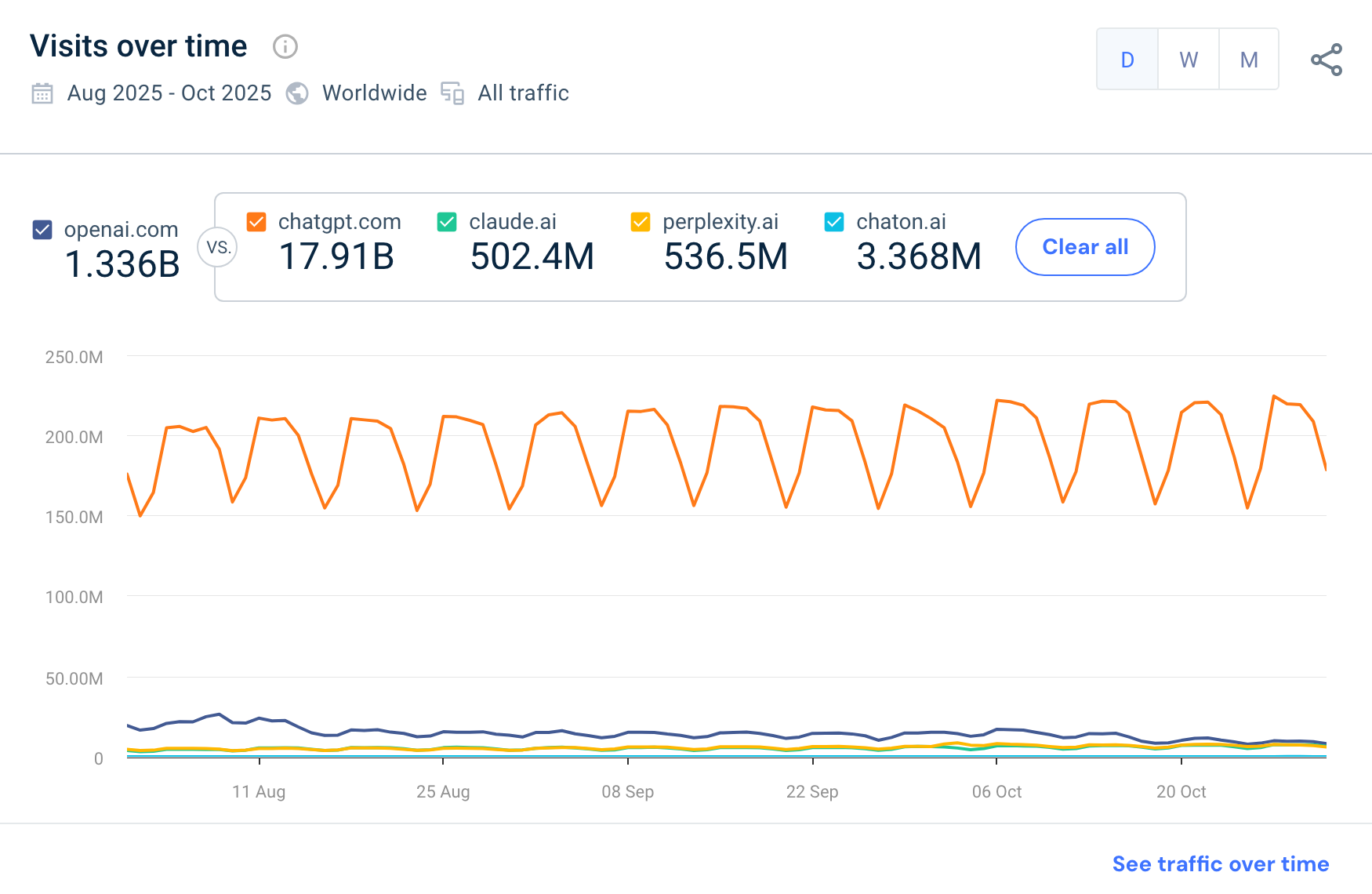
Across major models, growth has stalled for roughly six months. New users try AI, hit the same walls, and quietly disengage. The hype machine keeps running, but the usage curves tell a different story.
Why?
Because the core problems remain unsolved.
First, memory.
ChatGPT does not remember users in any meaningful, durable way. Each session resets the relationship. Users repeat themselves. Context evaporates. Workflows fracture. RAG was supposed to patch this, but instead introduced brittleness, hallucinations and trust erosion.
Second, governance.
Users cannot reliably control what the system does, does not do, or should never do. Enterprises cannot audit it. Regulators cannot reason about it. When something goes wrong, there is no clean chain of responsibility.
Third, revenue.
Token-based pricing is a false proxy. Tokens measure text, not cost. The same -sized token can require radically different compute depending on model path, hardware and workload. This obscures real economics, encourages waste, and terrifies CFOs who cannot forecast spend.
This is not an abstract critique. It shows up directly in capital markets.
Oracle just lost roughly 13 percent of its market value – $82 billion – after escalating AI capex failed to translate into revenue fast enough. That is not an Oracle problem. It is a business-model problem.
AI systems are enormously expensive to run. The dominant pricing models do not map to real cost. Investors see the mismatch. Wall Street hates mismatches.
And OpenAI sits squarely in the blast radius.
Three strikes and he’s out…for good?
That depends on how you score the inning.
- The ouster exposed governance failure.
- The leaks exposed internal instability.
- The current moment exposes a structural crisis: flat adoption, unsolved memory, unresolved governance, and a revenue model built on a convenient fiction.
None of these are cosmetic. All of them are existential.
Altman is a gifted fundraiser and storyteller, with no experience as a CEO. He has bought time before. But time is now the most limited resource in AI.
Markets are no longer rewarding vision alone. They are pricing risk.
For now, Sam Altman is not out. But is he at risk?
I dunno. I just call balls and strikes.