
Flipping the AI narrative from projection to facts

For two years, the world fed on a fantasy: AI was exploding.
Investor decks, media headlines, VC podcasts and earnings calls all pointed to the same kind of chart — the hockey stick. Growth was inevitable, exponential, unstoppable. AI would remake everything, on a timetable measured in months, not years.
The confidence was baked in.
The projection became the narrative.
And the narrative became “truth.”
But what actually happened?
When you look past the hype and pull the real numbers — not projections, not sentiment — the story changes instantly.
Instead of a hockey stick, we got a flatline.
From August to November 2025, real-world usage of consumer AI barely moved:
- Website traffic plateaued.
- App downloads stalled.
- Daily active use froze in place.
Across all the major LLMs — not just OpenAI — the trend was the same: flat.
The industry was staring at the projection, not the facts.
Adoption has stalled. Not slowed. Stalled.
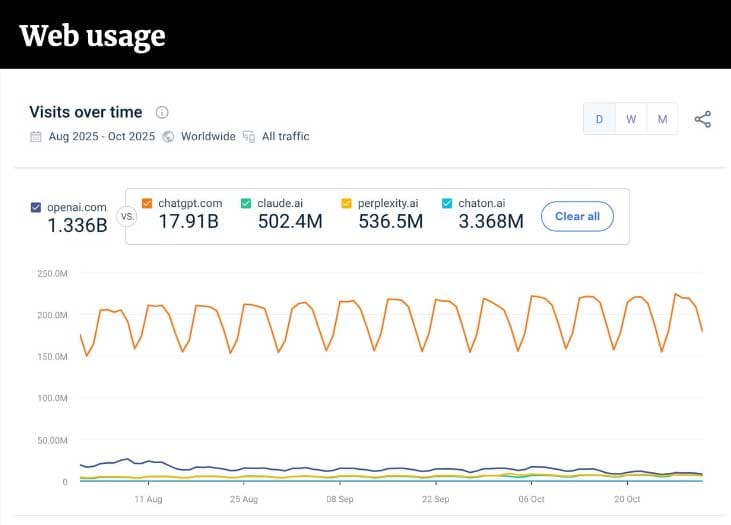
The numbers are not ambiguous. They are as clear as the flat curve in the graphic above.
So what happened?
Here’s the simple, structural truth the industry missed:
- No memory → The system forgets everything. Every time.
- No trust → Users disengage. You can’t build a relationship with amnesia.
- No adoption → Flat usage.
- No scale → No revenue.
Every other explanation is a footnote.
People don’t abandon AI because they dislike the output.
They abandon it because the system cannot remember who they are, what they’re doing or what they need.
You can’t build daily reliance on a tool that resets itself every session.
That’s the real adoption barrier — not hallucinations, not model size, not R&D budget, not GPU shortages. The absence of indelible memory killed the growth curve.
So what comes next?
The Overton Window and why this story is relevant now
There’s one more piece worth understanding: why this narrative — which was invisible six months ago — is suddenly resonating.
In political science, there’s a concept called the Overton window. It describes the range of ideas the public considers acceptable to discuss.
Inside the window: legitimate, debatable, mainstream.
Outside the window: fringe, radical, “unthinkable.”
For the past two years, the Overton window around AI was locked in place: AI is exploding. Growth is exponential. Adoption is inevitable.
Nothing outside that frame could be heard, no matter how true.
But facts have a way of moving the window.
Once the usage data went flat — once the facts contradicted the projection — the window shifted.
Suddenly, people could hear a new narrative: that AI wasn’t exploding; it was stalling.
That’s why this message is resonating now.
The numbers forced the window to move.
And what sits on the other side of that window is the truth — and the solution.
AI is exploding. Growth is exponential. Adoption is inevitable.
Anything that contradicted that — even legitimate evidence — fell outside the window.
People couldn’t hear it.
The narrative infrastructure wasn’t ready.
Then the usage charts went flat.
Not because of opinion.
Because of data.
And once the facts contradicted the projections, the window moved.
Suddenly, it became acceptable — even obvious — to discuss something that previously sounded heretical:
AI adoption has stalled.
People didn’t need to be persuaded.
They only needed permission to see what was already happening.
That’s the Overton Window in action.
Why understanding this shift matters
When the window moves, three things happen very quickly:
1. New questions become legitimate.
Why is adoption flat?
What structural barriers exist?
Why did the press miss it?
2. New solutions become thinkable.
Architectures that fix the underlying problem — like memory, trust, revenue models — move into the mainstream conversation.
3. The old narrative loses its monopoly.
Projection collapses.
Facts take over.
And that’s where the AI industry is right now:
Moving from projection to facts.
From assumption to evidence.
From hype to reality.