
Embarrassment is the strongest quality control system ever invented
Today’s AI scaled compute, not responsibility.
That worked—until it didn’t. Models got bigger. Data sets grew. GPUs multiplied. But reliability stalled, trust eroded, and adoption flattened. The problem isn’t intelligence. It’s ownership.
AI 2.0 doesn’t arrive through another parameter jump. It arrives through a structural reset.
The missing ingredient: ownership
Every system people truly trust has something in common: a name attached to it. Not a brand. A person. Or a very small team.
When no one owns the output end-to-end, quality degrades. Errors become “edge cases.” Hallucinations become “known issues.” Failures are absorbed by process instead of corrected by judgment.
AI 2.0 requires the opposite:
- one model
- one small team
- total ownership
- visible accountability
When the output embarrasses someone specific, quality improves fast.
How silos broke AI
Modern AI organizations didn’t fail because they lacked talent. They failed because they fragmented responsibility.
Today, a single model is typically split across:
- a research silo that trains it
- an infrastructure silo that serves it
- a product silo that wraps it
- a policy or safety silo that constrains it
- a communications silo that explains failures
Each silo is locally rational. Collectively, they guarantee incoherence.
No one experiences the system as a whole. No one feels failure personally. When a model lies, everyone can plausibly say, “That wasn’t my part.”
That is how you get impressive demos and unreliable behavior. Fluent text without truth. Confidence without memory. Intelligence without responsibility.
The historical precedent isn’t nostalgia. It’s physics.
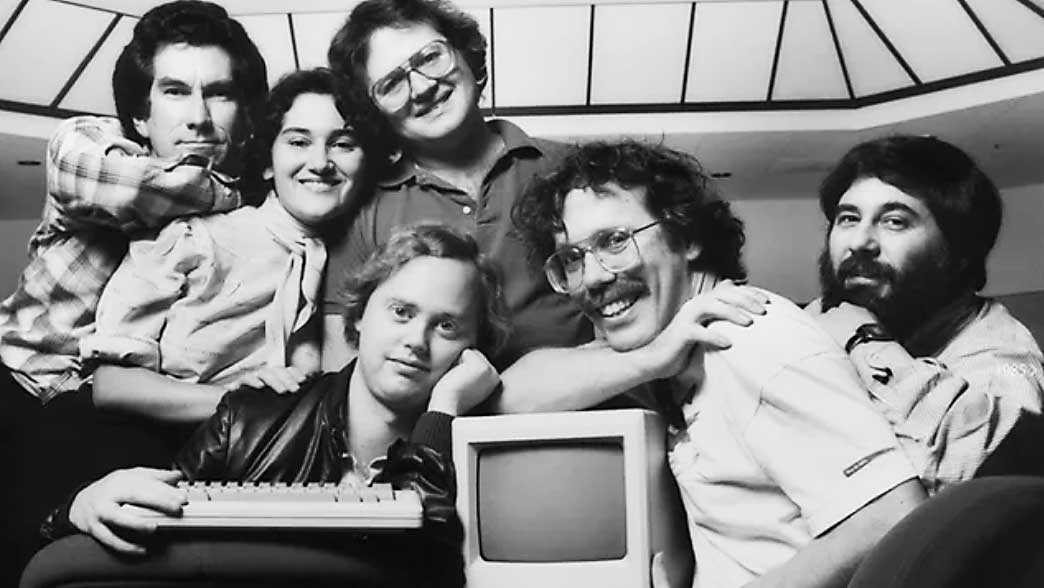
The original Macintosh didn’t come from a matrixed organization. It came from a skunkworks.
Roughly 20–25 people in 1981, co-located, multi-disciplinary, owning everything—from system software to typography to how the mouse felt in the hand.
That number wasn’t romantic. It was necessary given the tools of the time.
Today, we don’t need 25.
Modern tooling collapses distance. What took dozens of specialists then can be done by five or six highly competent people now—if they are allowed to own the entire product.
The pattern is consistent across history:
- small teams
- shared context
- no handoffs
- no diffusion of blame
- no meetings to reassemble meaning
Scale came later. Coherence came first.
The pattern repeats—even in modern AI
This isn’t just a story from the 1980s.
The most important breakthrough in modern AI didn’t come from a sprawling organization or a hundred-person task force. It came from a single, eight-person team.
In 2017, eight researchers authored “Attention Is All You Need,” introducing the Transformer architecture—the foundation of every large language model in use today.
GPT, Claude, Gemini, and their successors are all descendants of that work.
Eight people. One room’s worth of shared context. Total intellectual ownership of the idea.
Scale came later. Coherence came first.
What AI 2.0 looks like in practice
AI 2.0 is not a model size. It’s an operating model.
- Small, co-located teams
- Each team owns one model
- Names attached
- The same people design, train, deploy, govern, and live with it
- The same people answer for failures
- The same people fix them
No outsourcing. No silos. No remote diffusion of accountability.
The team owns:
- memory behavior
- governance decisions
- cost structure
- user experience
- failure modes
If it breaks, they feel it.
Why embarrassment matters
At senior levels, money and titles stop motivating. Reputation doesn’t.
People who have built things care about legacy. They do not want their names attached to something sloppy, misleading, or unsafe.
Embarrassment is not cruelty. It is feedback. It is the fastest way to close the loop between intent and outcome.
It is the strongest quality control system ever invented.
Why this won’t happen by default
Large companies are optimized to avoid embarrassment. They diffuse blame, add layers, and replace ownership with process.
That makes them good at scaling infrastructure—and bad at producing trustworthy intelligence.
AI 2.0 will not emerge from org charts or committees. It will emerge from protected skunkworks, crisis moments, or small teams operating above the bureaucracy.
Quietly. At first.
The path forward
We don’t need new benchmarks. We don’t need new hype cycles. We don’t need another trillion parameters.
We need to restore the simplest rule in engineering:
If you build it, you own it.
That’s how complex systems stabilized.
That’s how trust was earned.
That’s how great products were made.
That’s how we get to AI 2.0.