| What to listen for |
What this means |
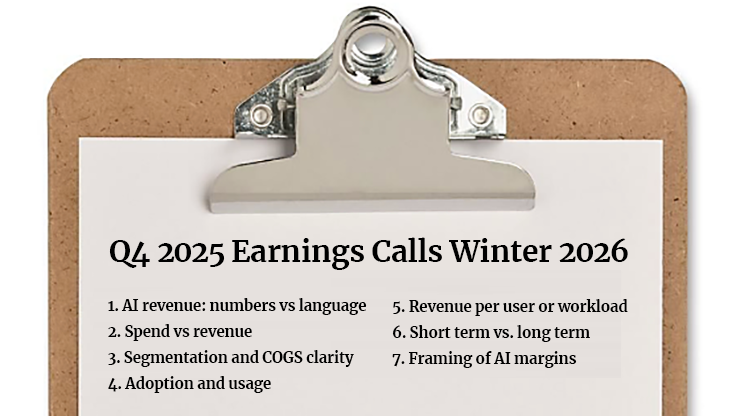
| 1. AI revenue |
|
|
Are AI revenues discussed in concrete dollar terms, or described using words like
“strong,” “early,” “encouraging,” or “meaningful”?
|
When revenue is material, it is quantified.
Continued reliance on adjectives suggests AI revenue is still immaterial or uneven.
|
| 2. Cost recovery |
|
|
Advances in efficiency and scale will offset rising compute expense. Token-based or flat-rate pricing will recover cost.
|
No mechanism exists for compute efficiency to improve with scale. Compute increases with larger context windows, multimodality, agents and safety layers. Tokens are an inaccurate usage proxy, not a compute meter, and flat-rate pricing severs price from cost entirely. So, as adoption grows, inference costs scale up, not down.
|
| 3. Spend vs revenue |
|
|
Discussion of increased spending on compute, data centers or infrastructure
without a clear link to revenue.
|
Costs are scaling faster than returns.
Even with growth, margins may compress if spend outpaces monetization.
|
| 4. Segmentation |
|
|
Whether AI is reported as a standalone segment, including any discussion of
AI-related COGS, or blended into cloud, services or platform results.
|
Blended reporting and absent COGS disclosure indicate AI economics are not yet
independently stable or ready for direct margin scrutiny.
|
| 5. Adoption and usage |
|
|
Whether management provides adoption and/or usage trends or avoids adoption and usage metrics entirely.
|
If only year-over-year data is offered, this may obscure the reported stall which began in Spring 2025. If short-term adoption trends and/or usage are not discussed, they may no longer be accelerating.
|
| 6. Revenue per user or workload |
|
|
Discussion — or absence — of revenue per user, per seat, per query or per workload.
|
Without revenue density metrics, it is difficult to assess whether growth scales
profitably or dilutes margins.
|
| 7. Short term vs. long term |
|
|
Guidance framed primarily in the long term, such as “early innings” or
“multi-year opportunity,” rather than near-term contribution.
|
Management is signaling limited short-term visibility into AI margins, usage, adoption or cash-flow impact.
|
| 8. Framing of AI margins |
|
|
Direct questions about AI margins that are answered indirectly,
deferred, or reframed.
|
Margin structure is still evolving, internally sensitive,
or not yet favorable enough to discuss explicitly.
|