
Apple bets on AI-lite, hopes users will pay $1,000 to use Google’s LLM. Is this intelligence, Apple?
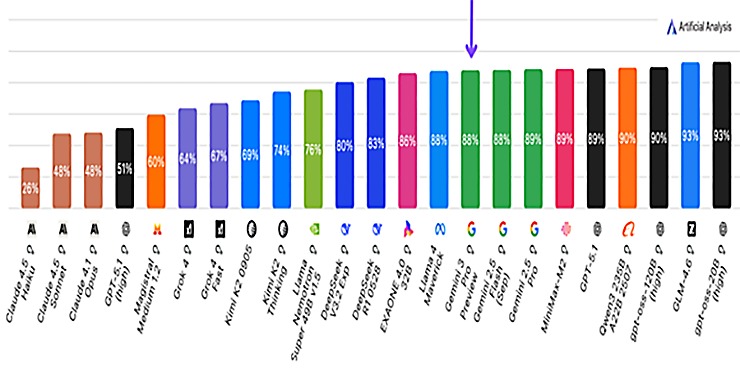
Apple is outsourcing Siri to Google’s Gemini 3.0 — a model that hallucinates 88% of the time when it doesn’t know the answer. Hallucinations already sank Gemini 1.0, and now Apple is baking them into its brand. But Apple built its empire on trust — and hallucination is the opposite of trust.
Artificial Analysis Omniscience Hallucination Rate
Omniscience Hallucination Rate (lower is better) measures how often the model answers incorrectly when it should have refused, defined as the proportion of wrong answers out of all non-correct attempts. Gemini 3.0 is 88%
Takes your breath away, doesn’t it? Now take a breath, and continue…
Apple’s AI strategy for spring 2026 is coherent, but it offers less than Google’s Gemini does right now in 2025, hallucinations and all.
What Apple is planning for Siri is not an assistant that remembers you. It’s an assistant that understands what’s on your screen in the moment. When you close the app or move on, that understanding disappears.
This is not an accident.
Apple has built its brand on privacy, control and predictability. Letting software remember users across time raises uncomfortable questions. So Apple is choosing limits. The system can see, but it can’t remember.
The result will be a better Siri. Faster. Cleaner. More helpful in the moment. But it won’t improve over time in how it understands you. Learning requires memory, and this version of Siri does not remember across time.
That matters.
Technology without 100 percent loss-less memory can’t compound value. Each interaction starts from zero. There is no progress or iterative learning, because each session starts from scratch.
Now the business problem.
Apple has no direct way to make money from AI. There is no paid version planned for the first release. For now, AI is simply an expense.
The only payoff Apple can point to is hardware upgrades — the hope that people will spend $1,000 or more on new iPhones to get these features.
That’s a risky bet.
The AI Apple plans to offer in 2026 is already less capable than what Google’s Gemini provides users today, for free, on existing devices. Gemini can remember some past interactions. Siri could, but won’t.
Apple’s approach is safer. It is also weaker.
People don’t spend more than $1,000 on new phones for small improvements. They buy them when something gets meaningfully better the longer they use it. If that doesn’t happen, AI stays a cost.
Apple appears to know this. That’s why monetization is delayed. That’s why expectations are carefully managed.
Caution may buy time.
But while Apple frets, its competitors move forward.
And here’s the kicker: Apple Intelligence will be driven by Google’s AI, not its own LLM. Apple is betting that you’ll pay north of $1,000 to use a throttled version of Gemini.
Only a fool bets against Apple.
But this time, I’d take that bet, because—
The transformation is complete.
Apple is now Tim Cook:
- Meticulous
- Risk-averse
- Always on message
And not the Steves – Jobs & Wozniak:
- Inventive
- Unfiltered
- Willing to blow it all up to build what’s next
Is it any wonder all bets are off?
So, here's the deal:
I don’t have Cupertino polish.
My mind is not One Infinite Loop.
I design, but not in California.
But Apple needs to deal with me.
Because I have the one thing they don’t: FTO