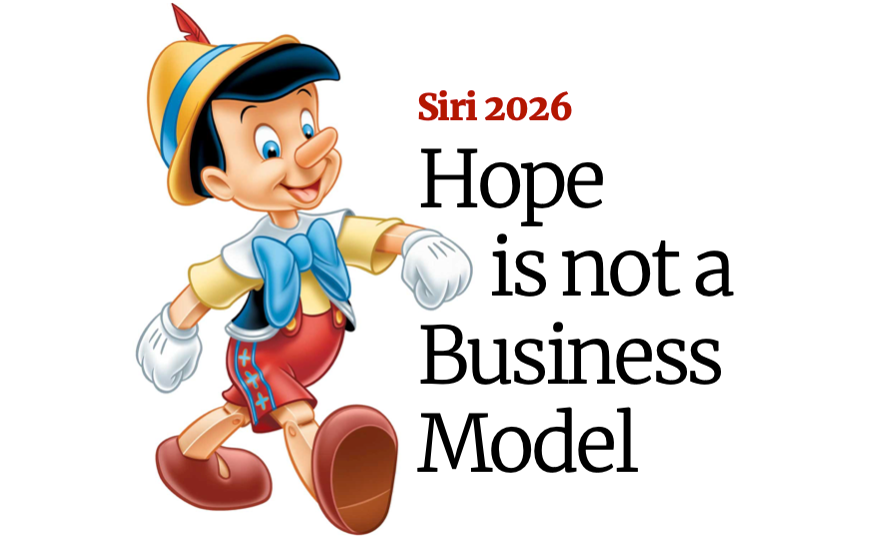
An open letter to Tim Cook: You’re about to lose trust with your users

Dear Tim,
There’s more hype and heat around AI than at any time in modern tech history.
- Anthropic is valued at $350B on a growth story that doesn’t survive a reality check.
- OpenAI is in recurring governance hot mess.
- Google is making a second attempt with Gemini. It thinks better reasoning can overcome an initial trust failure. But the barriers to scale can’t be scaled with better compute.
And Apple?
Apple is conspicuous by its absence.
A note on why Apple’s plans for Siri risk repeating Google’s mistake.
For the first time in a major platform shift, the world’s most valuable brand is not in the driver’s seat. Instead of setting the agenda, Apple appears to be watching from the sidelines—careful, quiet and institutionally cautious. Even the name tells the story:
“Apple Intelligence.”
It sounds corporate. Defensive. Safe.
Not something for and by the cool kids.
That should worry you.
Apple has always won platform shifts not by being first, but by being right. By shipping systems people trust with their lives, their photos, their money and their private thoughts.
Which raises the real question:
Is Apple being careful—or is Apple stuck?
Because AI 1.0 is not something Apple can ship safely.
And that is Apple’s dilemma.
Apple’s advantage has always been trust. But trust cuts both ways. It gives Apple power—and it gives Apple constraints that other companies don’t have.
- Apple cannot afford hallucinations.
- Apple cannot afford opaque governance.
- Apple cannot afford a flat-rate or token-based revenue model that ignores compute.
In other words, Apple cannot go “all in” on AI the way everyone else has.
Which may be why Apple seems to be waiting.
But time, tide and platform shifts wait for no one. In the meantime:
AI 1.0 is off-brand for Apple.
AI 2.0 is on-brand for Apple.
That distinction matters.
Because unless Apple moves beyond AI 1.0, it risks missing the shift entirely—not because it was slow, but because it refused to ship something that would break trust with its loyal users.
Which brings us to the same three problems blocking AI adoption everywhere —and the reason Apple cannot simply follow the pack.
1. Memory
Large language models survive their memory limits the same way JPEGs survived slow networks: through lossy compression.
JPEGs throw away pixels.
LLMs throw away facts.
At first glance, the loss isn’t obvious. But look closely and the seams appear: blurred edges, missing detail, artifacts that weren’t visible at first. With LLMs, those artifacts are broken continuity and missing truth.
What JPEGs lose are pixels.
What LLMs lose is truth.
Apple cannot ship AI built on lossy memory. Not at scale. Not with its brand.
Without 100% loss-less memory, AI cannot be trusted. Without trust, there is no adoption. Without adoption there is no scale. And without scale, the market caps tied to AI infrastructure evaporate.
If you believe memory is a problem Apple can solve later, please know that a solution to this problem has been filed and is patent pending.
2. Governance
Apple does not ship systems it cannot control—but users want control, too.
AI systems must give users agency:
over how they behave,
when they escalate,
when they refuse,
and how they explain themselves.
Governance cannot be implicit, opaque or centralized. That may be tolerable for demos. It is incompatible with Apple’s brand promise.
Joni Mitchell never accepted an instrument as it was handed to her. She tuned it — again and again — until it matched the sound she heard in her heart. She custom-tuned her guitar for many of her songs, including “California.”

Governance in AI should work the same way: not as control imposed from above, but as user-level tuning that lets people shape how the system behaves, remembers and responds.
Apple’s customers expect control, clarity and accountability. An AI system that cannot be governed by its user is not an Apple product.
If you believe governance is a problem Apple can solve later, please know that a solution to this problem has been filed and is patent pending.
3. Revenue
Apple has never shipped arbitrary pricing.
Flat-rate subscriptions don’t scale at the enterprise level. Token-based billing doesn’t measure cost. Tokens measure words. Words are a terrible proxy for compute.
Consider two scenarios:
A user talks to AI for thirty minutes about his girlfriend:
How she seems distant.
How she is slow to respond to texts.
How she is mysteriously unavailable.
The system dutifully transcribes every word, responds empathetically and consumes a massive number of tokens — all while avoiding the four words a human would scream immediately: SHE’S CHEATING ON YOU!
Now consider a three-word query:
“Is God real?”
Few questions demand more reasoning, context, philosophy and depth. Yet under token-based billing, that interaction may never recover the cost of compute.
That alone should end the debate over billing.
Tokens are not compute. They are a proxy—and a inaccurate one. If you want to bill for cost, you must meter compute.
And if you believe compute-based metering is something Apple can defer, please know this:
It’s not impossible. It’s patent pending.
Siri is Apple’s canary in the coal mine
Not because Apple doesn’t know how to build AI — but because Apple knows exactly what not to ship.
Every other platform rushed conversational AI to market and accepted hallucinations, data leakage, opaque training and loss of user agency as “good enough.”
Apple didn’t.
The result is conspicuous silence — and a voice assistant that now feels dated, constrained and increasingly out of place on otherwise world-class hardware.
That tension matters.
Siri isn’t failing because Apple lacks capability.
Siri is stalled because AI 1.0 violates Apple’s core values: trust, privacy, predictability and user control.
Until those conflicts are resolved, Siri can’t evolve safely — and Apple knows it.
Right now, Apple’s silence is being interpreted as caution.
But history shows that choosing to remain outside the arena has consequences.
On the other hand…