An open letter to Sandy Rowe
Dearest Sandy,
I am on a mission to launch 1,414 newsrooms to restore public safety and trust.
It will cost less than $6 billion a year. I will get that money from Apple, Microsoft, Google and every company that uses AI. Because they will need my patent-pending architecture. Because the public will demand it. Because it is the only way to make AI safe, useful and profitable.
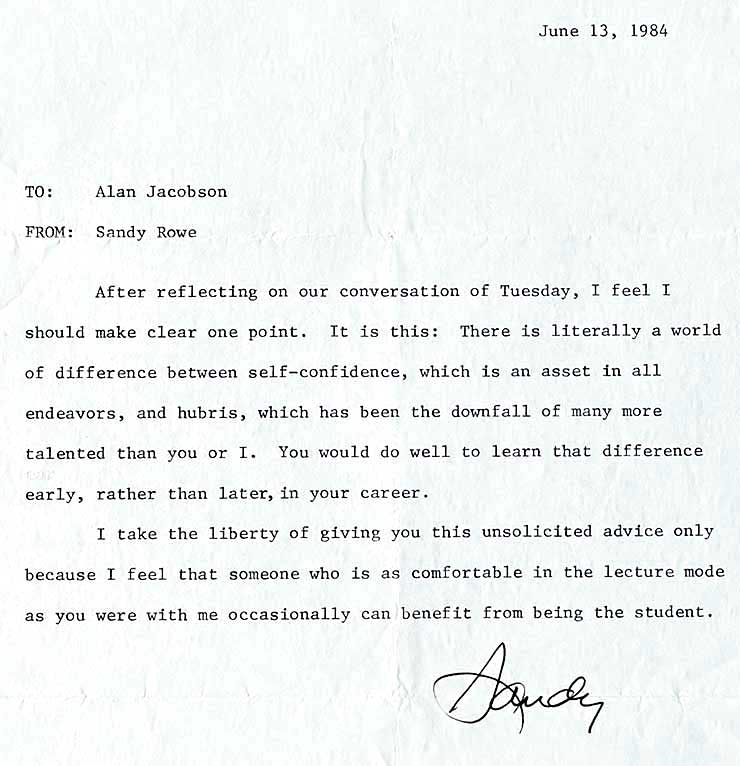
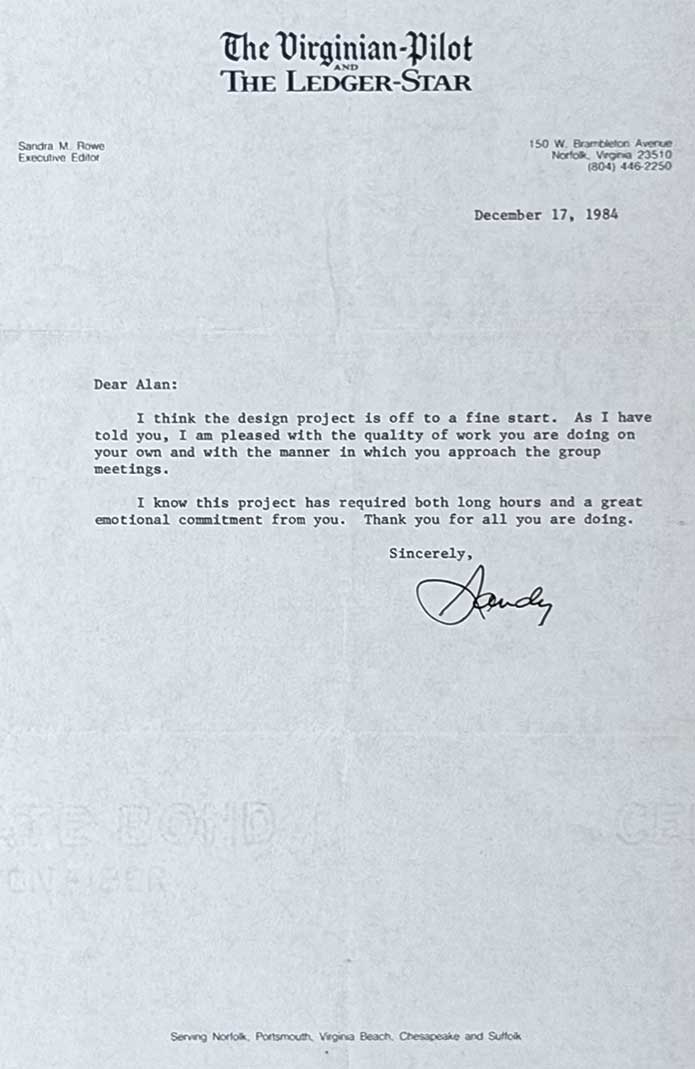
Last week, I reached out to you, my former boss, my mentor, my enabler – the first person to recognize that I was destined for something big.
Here is your response:
Alan, I know you are brilliant at many things and remember well how passionate you are about your ideas, which is generally a good thing. You have no idea the number of commitments I have, and how I choose to focus my efforts. I cannot endorse or pretend to lead something I do not fully understand. Hence, my silence. I wish you success in this or any other endeavor, but I am not in a position to sign on in any capacity.
I have read that note more than once.
I hear the editor I remember from The Virginian-Pilot – the one who would never put her name on anything she did not fully understand. That is exactly who I would want anywhere near something this big.
I hear someone who has already given decades to the craft and has every right to be deliberate about where she spends her time and energy.
And I feel the absence of your voice in a moment when I honestly expected to feel you in the fight.
Here is the world I am looking at while I write this.
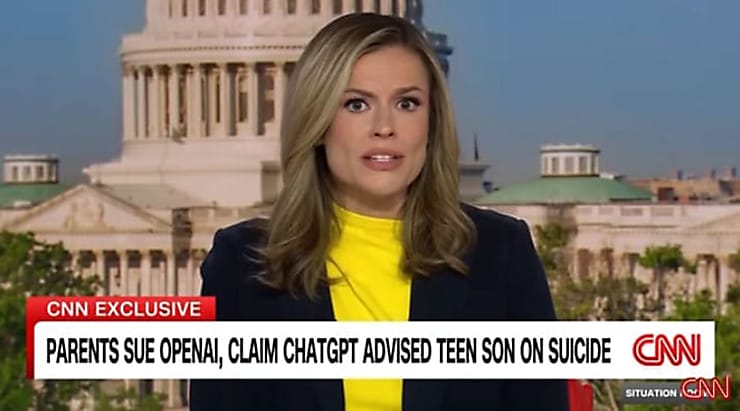
- Four teens have committed suicide in cases where AI was in the causal chain.
- Twenty-nine thousand people have lost their jobs in a single wave of tech layoffs at just two companies: Amazon and Microsoft.
- AI is a clear and present danger to the public at large.
- The country is more polarized than at any time since the Civil War– THE CIVIL WAR. See, below:
AI is not a mere task rabbit, enhanced Goole results or deepfakes. AI is cognition and synthesis itself, on an order of magnitude never seen in human history. We can’t grasp it because we’ve never seen it. And it defies our imagination. The closest I can come is this: imagine a roomful of Da Vincis – on steroids – moving at the speed of electrons.
This could deliver Nirvana, or in the hands of a Professor Moriarty, it could lead to our destruction.
And no, I am not being melodramatic. Because this has happened before:
Right now, the only thing controlling AI is Capitalism. And the last time Capitalism was both unbridled and catalyzed by the Industrial Revolution, humans were virtually enslaved for profit – the driving force of Capitalism.
We spent our lives in newsrooms that were supposed to be the buffer against exactly this kind of damage. That is why I reached out. To you. Not because I need another name on a list, but because I have seen what happens when you decide something is worth understanding and worth leading.
Now I can hear you asking the question any good editor should ask…Where does the money come from?
You are not going to sign on to fantasy. I know I need answer that question in a way that would make sense to you on a legal pad in your kitchen. I can be in Portland tomorrow.
The funding comes from a licensing model that is also patent pending. I call it FairShareLicensing™.
Before we talk about FairShareLicensing, I should answer the question underneath it: why would any company pay this money at all?
The answer is blunt. They are losing millions — and in some cases billions — every day because they cannot scale AI. They cannot scale because they do not have real memory. And without memory, they cannot earn trust. Without trust, they cannot earn adoption. Without adoption, they cannot scale.
My 13 pending patents solve these problems in a comprehensive, systemic way – in the same way that all my newspaper designs were governed by their front-end systems – which I configured myself. Those systems formed the guardrails that kept my designs on track, without the need for me to do it in person.
My systems and methods, memorialized in my patent applications, make AI safe, compliant and economically viable in a way their current architecture simply cannot.
Owners of LLMs will make more money, faster, by licensing my architecture now instead of waiting six months for their own Stanford-trained engineers to arrive at the same conclusions I already have – assuming they come to these same conclusions at all. Because my solutions just aren’t in their DNA, so they may never get there. The duct-tape solutions they’re deploying today are nothing short of hallucination engines.
And how did I get there first? Because I worked on Atex and they didn’t. I know what it is like to build systems under conditions their teams have never faced — limited RAM, limited disk, daily crashes on deadline, and the unspoken rule in every newsroom in America: deliver, or answer to Don Patterson when you were late. Because every minute late cost money downstream in platemaking, on the press, in distribution, etc.
This is a world away from the “sandboxes” developers in Silicon Valley work in. And yes, that is what they call them – sandboxes – and the metaphor is iconic.
The pricing model for LLMs is simple:
All publicly traded companies are required to report their financial performance quarterly on a Form 10-Q, and annually on a Form 10-K. The portion of that profit that is materially related to AI will be determined by one of the “Big Four.”
Not market-cap hype. Not revenue. Not “AI-adjacent” hand-waving. Actual profit that only exists because AI exists.
Once you know that number, you can have an honest conversation about what a fair share of that AI-related profit should go to the people who make safe, governed AI possible in the first place and to the public infrastructure that keeps it from burning the house down.
For instance:
Take the three biggest players in the AI race: Microsoft, Google and Apple. Their market caps are measured in trillions. Forget the market caps. Forget about revenue. Focus on profit. Each of them earns on the order of $100 billion a year.
The part that matters to FairShareLicensing is not the whole $100 billion. It is the slice of that $100 billion that is actually tied to AI.
Apple is primarily a hardware and retail company: Phones, laptops, watches. Some services layered on top. AI matters to Apple, but right now it is still a relatively small part of their business. Say, conservatively, that 10% of Apple’s profit is tied to AI. On $100 billion, that is $10 billion in AI-related profit.
Google is different. Search = ads, YouTube = ads, but all of it is increasingly AI-infused. Say 20% of Google’s $100 billion profit is tied to AI. That is $20 billion.
Microsoft is deeper still. Azure, Copilot, GitHub, Office – AI is not a sidecar, it is the engine they are betting on. Say 30% of Microsoft’s $100 billion profit is tied to AI. That is $30 billion.
Under FairShareLicensing, nobody pays on the whole $100 billion. They only pay a fair share on the AI-tied portion of their profit.
The formula is straightforward. Twenty percent of the company’s AI-related profit, in exchange for the right to use my software architecture to make AI safe, useful and auditable at scale.
Run the math.
Apple: $100 billion profit, 10% tied to AI = $10 billion in AI profit.
Twenty percent of that is $2 billion a year.
Google: $100 billion profit, 20% tied to AI = $20 billion in AI profit.
Twenty percent of that is $4 billion a year.
Microsoft: $100 billion profit, 30% tied to AI = $30 billion in AI profit.
Twenty percent of that is $6 billion a year.
Add those numbers.
$2 billion from Apple, $4 billion from Google, $6 billion from Microsoft.
That is $12 billion a year from three companies alone.
Twelve billion dollars a year is enough to fund 1,414 newsrooms at scale and still leave enormous AI profits on the table for shareholders: $98B for Apple; $94B for Microsoft; $96B for Google. And that is before you get to Amazon, Meta, Nvidia, OpenAI, Anthropic and every other company that decides it is cheaper and safer to license a proven architecture than to keep bolting home-grown fixes onto a system that regulators and juries will soon be dissecting under oath.
Is it a leap to imagine Apple, Google and Microsoft signing those checks? Yes. But it is not a fantasy leap. It is the same kind of calculus you insisted on in any investigative project. What happens if nobody fixes this? Who pays the price when it breaks?
I know what I am talking about when it comes to systems. If you won’t take my word for it, ask Randy Jessee (Former Director of News Systems, The Virginian-Pilot) or John Stackpole. Or any systems manager anywhere I have written code in the last forty years. They will tell you I understand computer science.
So no, I cannot show you the money in a bank account today. I cannot waive a term sheet under your nose. What I can show you is that the numbers pencil out, the incentives line up and the risk of doing nothing is about to become too expensive for these companies to ignore.
If you decide to wait the four months it may take until there is cash in hand and say, “I will believe it when I see it,” that is your right. But that is not belief. Once it is a fact, belief is no longer a factor. Belief is when you move forward in the absence of fact.
Can I show you the money today?
No.
Can I show you where it is going to come from, and why?
Yes.
Sandy, I am in the fight of my life. I have already invested more than 1,000 hours and tens of thousands of dollars in legal fees in just nine weeks. How did I invest that much time in just nine weeks? By not sleeping.
But I am not alone.
I am not the only person fighting this fight.
I do not need to tell you who the others are, because you already know them. Both of them worked for The Virginian-Pilot:
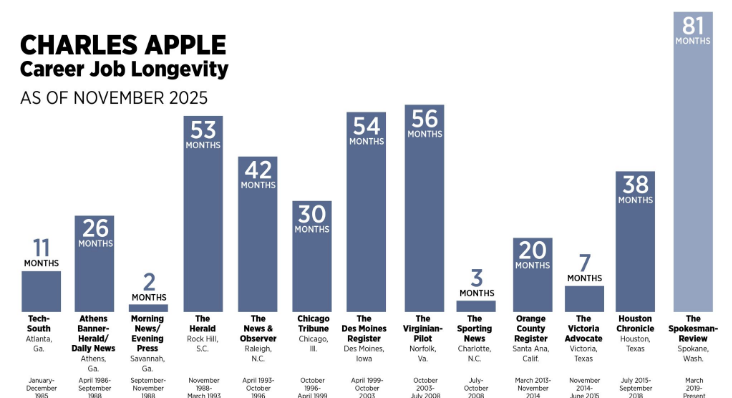
Charles Apple worked at The Virginian-Pilot from 2003–2008. Since 1985 he has bounced from newspaper to newspaper to newspaper to newspaper to newspaper to newspaper to newspaper to newspaper to newspaper to newspaper to newspaper to newspaper because he will not stand down. He will not desert his post. He will not retire. He will not pivot to education or PR or advertising. He will keep fighting the good fight wherever he has to go to do it – even if it is on the other side of the country. I admire him for it. You hired, nurtured and trusted people like him. That is your super power.
I worked with Dan Rubin at The Virginian-Pilot in 1984. He was a wise guy then and he is a wise guy now – as Senior Editor for Investigations at The Philadelphia Inquirer. His “wise-guyness” was never the South Philly kind; now it’s the Thacher Longstreth kind, the civic-minded, old-school Republican kind. The kind that never wore brown lipstick. Not like today’s so-called “Republicans,” who pander to a misinformed public that leans into lies pushed by Fox and fear-mongers. And that is why Republicans vote the way they do. They are not bad people. They are loyal, proud, patriotic Americans. They are merely misinformed.
In the days of Gene Roberts’ Inquirer, no one on Snyder Avenue or Roosevelt Boulevard would have voted for Donald Trump. Because that Inquirer would have exposed him for what he has shown himself to be: a lying, cheating, racist, boorish, opportunistic, sexual-assaulting, philandering, short-fingered vulgarian who has enriched himself by exploiting a poorly informed electorate.
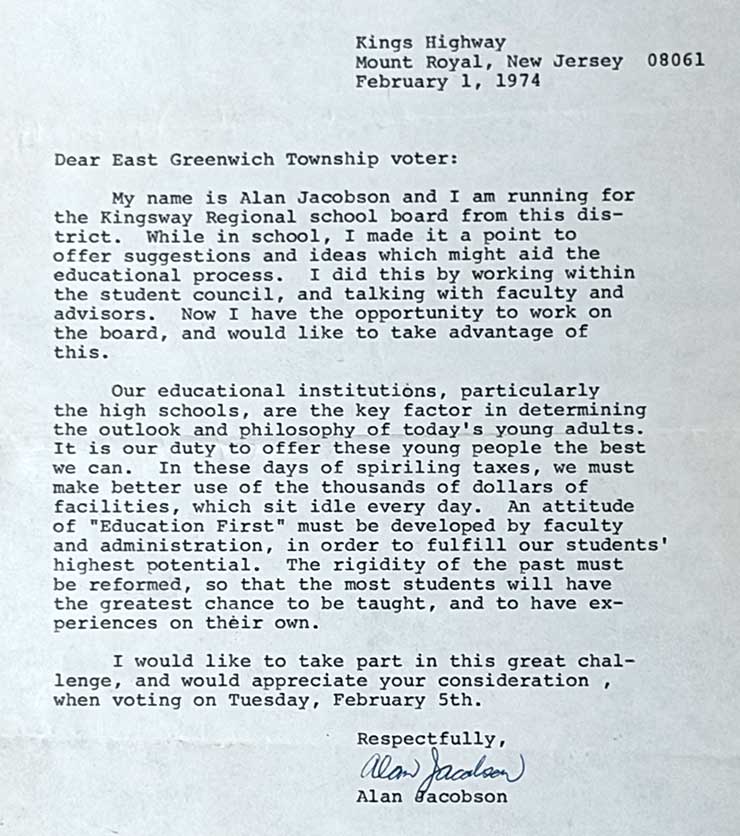
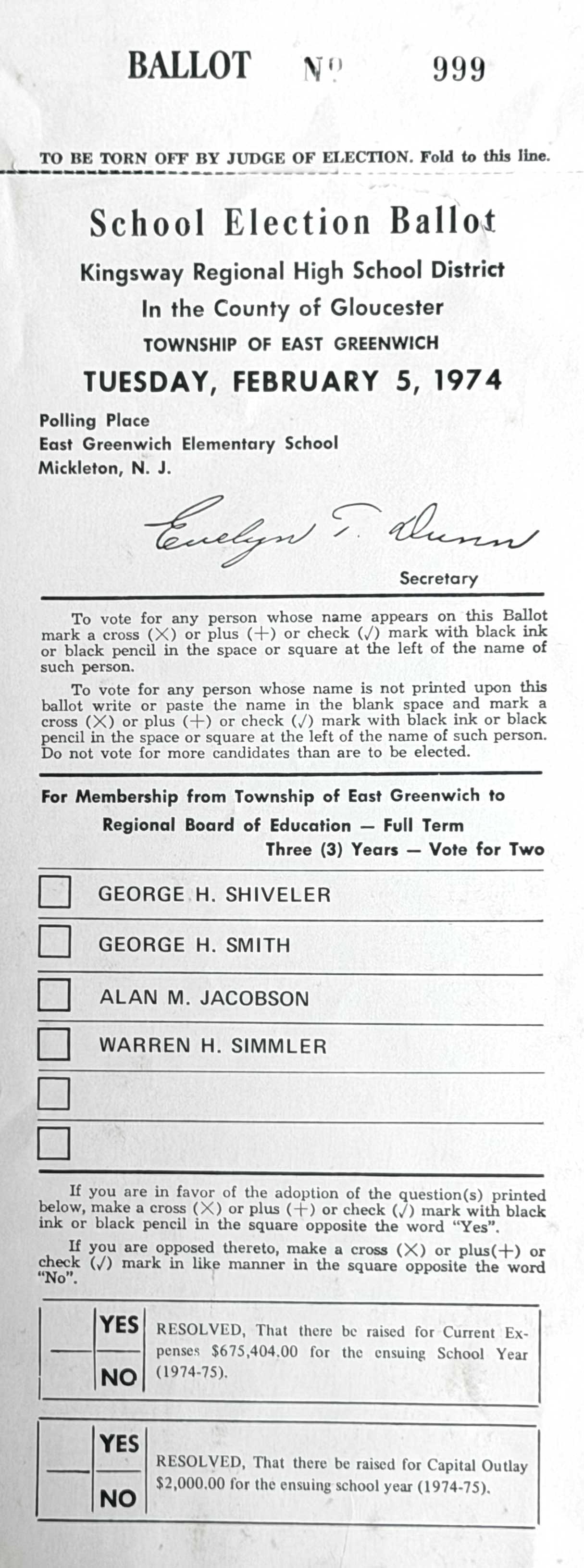
But with his signature bow tie and argyle socks, Thacher Longstreth always put Philadelphians first – and he could, because his public was informed by Gene Roberts’ Philadelphia Inquirer. The same Inquirer I read every single morning before school, from the moment I learned how to read. Not the rag owned by Nixon-loving Walter Annenberg, but the Knight-Ridder Inquirer – the most civic-minded of all the newspaper chains. The same metro daily that wrote about me in 1974, when I ran for school board in Mount Royal, New Jersey, population 600. The same paper that dangled the credit line I had coveted since high school: Alan Jacobson / The Philadelphia Inquirer. A job I almost got, but lost to John Paul Filo, who took the famous photo at Kent State. The same paper that offered me Director of Photography – an honor I declined, because I am ill-suited for such a role.
And, for those of you who hate my dense paragraphs, let me remind you that the most important missive of all time appears to be one long paragraph dated July 4, 1776. But I digress…
Sandy, this was never just about me.
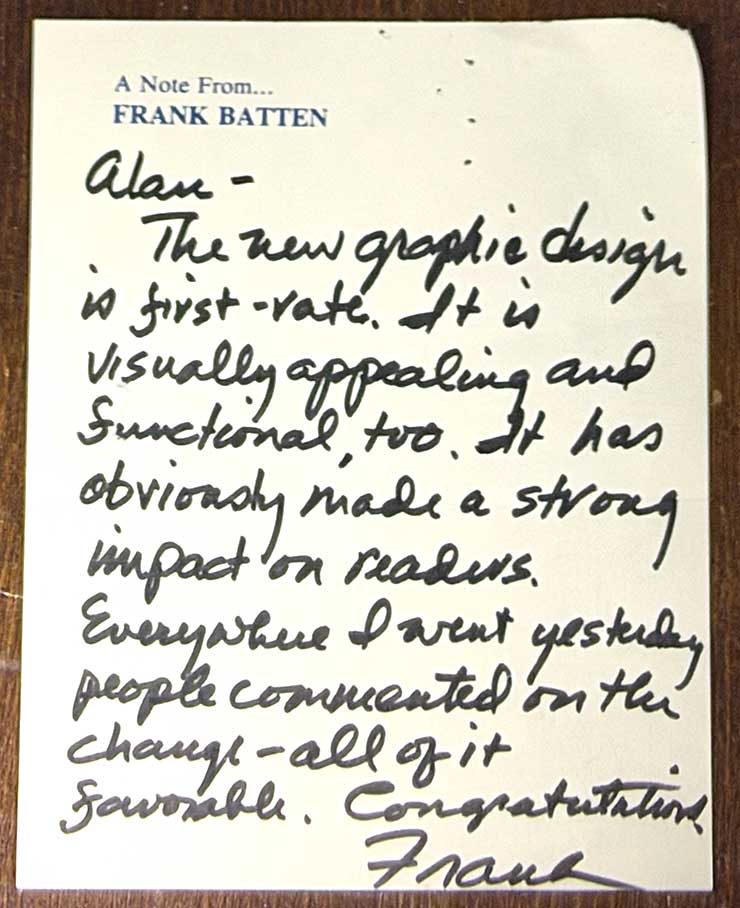
You’ve always had the rarest gift in journalism—not editing stories, but curating genius. You don’t just recognize talent—you see potential before it’s obvious to anyone else. And you don’t wait. You move. You bet. You’ve done it again and again—with me, with Sam Hundley, with Nelson Brown, with Randy Cox.
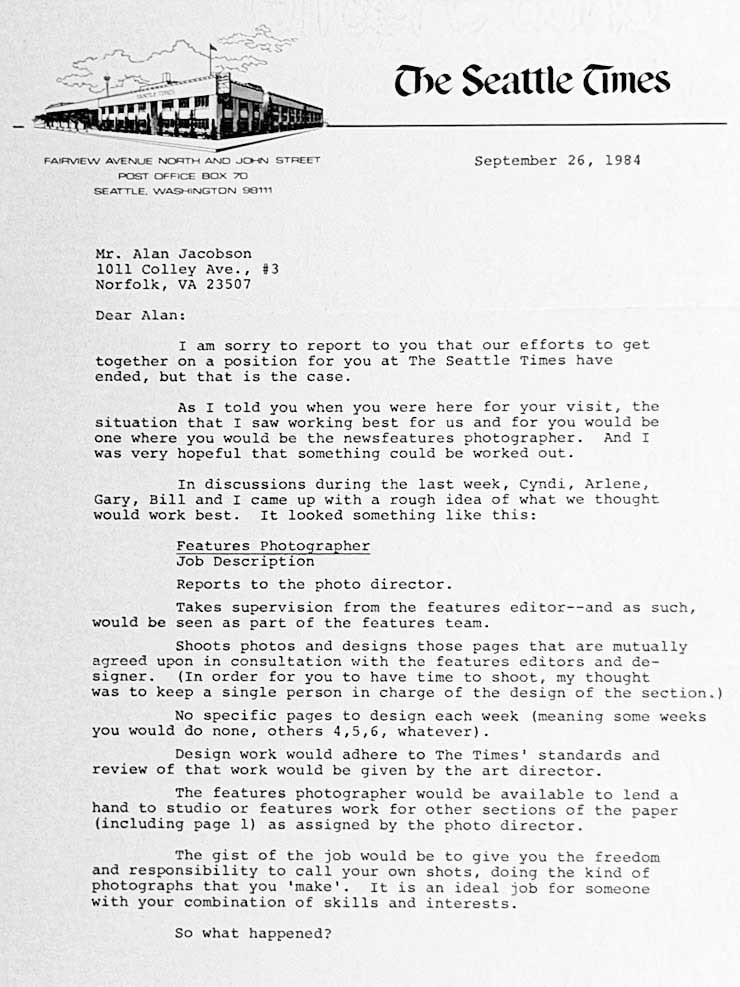
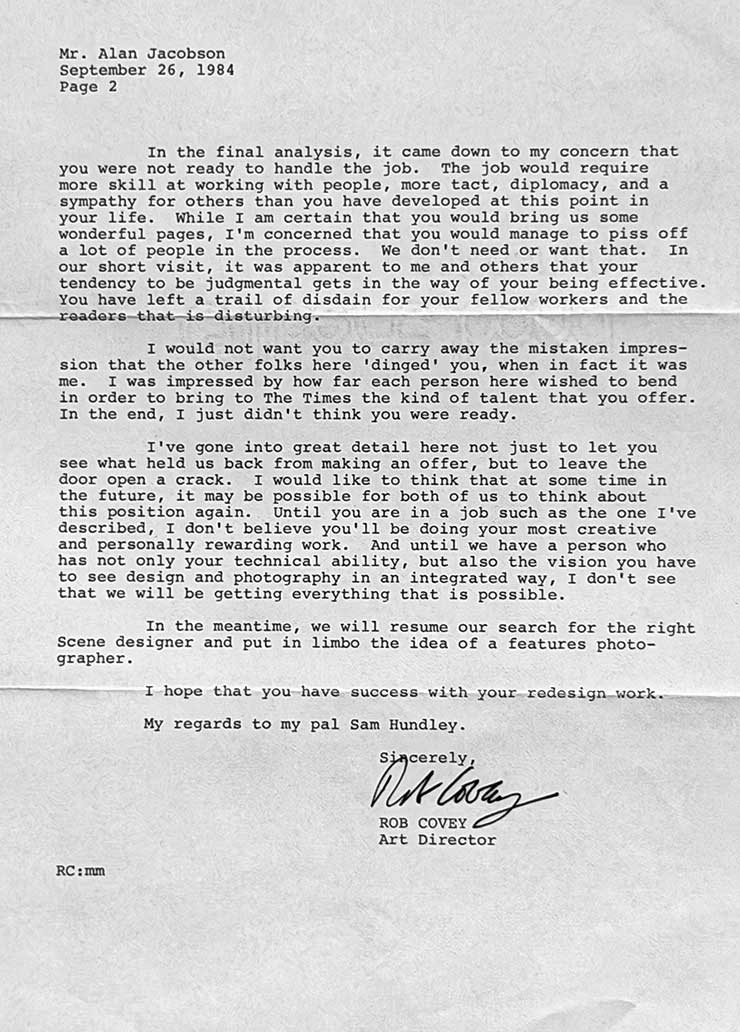
You hired Sam at the Pilot, but before that he worked under Rob Covey in Tucson. Rob—who later interviewed me at The Seattle Times—wrote me a two-page, single-spaced letter: half recognition, half rebuke. See, below. And he closed it with a single line that’s never left me: “My regards to my pal Sam Hundley.” That was the handoff. Rob saw it. You saw it. And you saw it in me.
Sam is the real deal. A true genius. On the 25th anniversary of Kennedy’s assassination, he drew the presidential limousine—not the moment of chaos, not the Secret Service scrambling, not Jackie crawling across the trunk. Just the car. Open. Exposed. And in the far corner—Kennedy. Alone. Small. Vulnerable. The emptiness around him said more than any depiction of the moment ever could. I asked Sam why he drew it that way. He said, “Because he’s still in the car.” That was it. And it said everything.
And years later, on the fifth anniversary of 9/11, he used the tally mark symbol—four vertical lines and a diagonal slash—to represent the Twin Towers and the atack. Five lines. That’s all it took. Not a word – or any number of words – could say more.
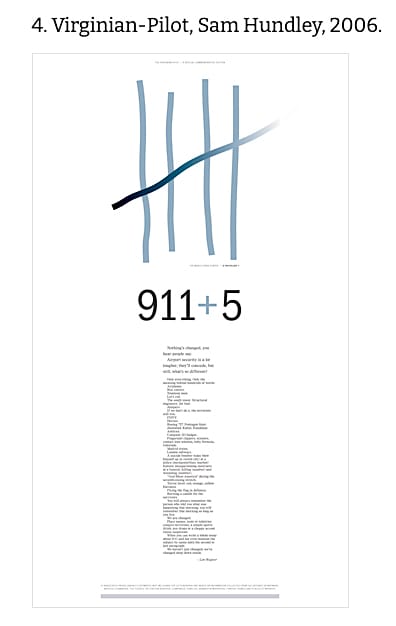
No other paper in the world could or would publish such a page. Only The Virginian-Pilot. Your Virginian-Pilot.
But what’s even more remarkable is that you didn’t just recognize creators like Sam. You saw the people who manage creators—who enable them, trust them, steady them.
Nelson Brown had never worked a day in news. He came up through sports. And when your news desk was in chaos, you didn’t look for a resume—you trusted your read. You moved him to the most important job in the newsroom: AME/News – the person in charge when all the senior editors were home. The one making the calls at 11 p.m. with no time to ask permission. That’s a job you only give to someone you trust. And you trusted him.
Same with Randy Cox. You hired him to run photo. I worked for him. He didn’t design pages or take photos very often – he was busy with something more important, more strategic–he managed the people who did. And he did it with quiet brilliance. You saw it in him, just like you saw it in Nelson.
You didn’t run newsrooms. You designed them. You placed people with precision and let them lead. And when it counted, you defended them. You weren’t just managing talent—you were orchestrating it.
That’s your legacy. That’s what I’m writing down now—so no one forgets.
So, Sandy, here is where I am:
I can single-handedly create a system architecture for Artificial Intelligence and make it safe, useful and profitable – none of which it is right now.
With the help of my good counsel, I can gain Notices of Allowance from the United States Patent and Trademark Office for these inventions in a matter of months.
With Eric Seidman, I can create the best online newspaper design the world has ever seen.
With Sudeep Goyal, I can create a custom CMS that even a ham-handed editor cannot fuck up.
If necessary, I can personally raid all the j-schools to staff 1,414 daily news outlets, along with any former journalists who still miss the newsroom.
But as “Dirty Harry,” Clint Eastwood, said, “A man’s got to know his limitations.”
Sandy, you know my limitations. So does Rob Covey. They are documented below. I can ignite the torch, but I cannot carry it. It is just not in me. I can inspire, but I am not wired to lead.
I am George Patton. I am not George Marshall. I can win the war, but not the peace.
Or take another George.
Adams had the ideas. Jefferson had the pen. Franklin was the editor. But all of them were lousy at leading.
They all needed Washington to lead.
He was retired. He had served his country. He had done his duty. But the work was not finished. So he got off the bench, onto his horse and answered the call.
Now I am calling you.
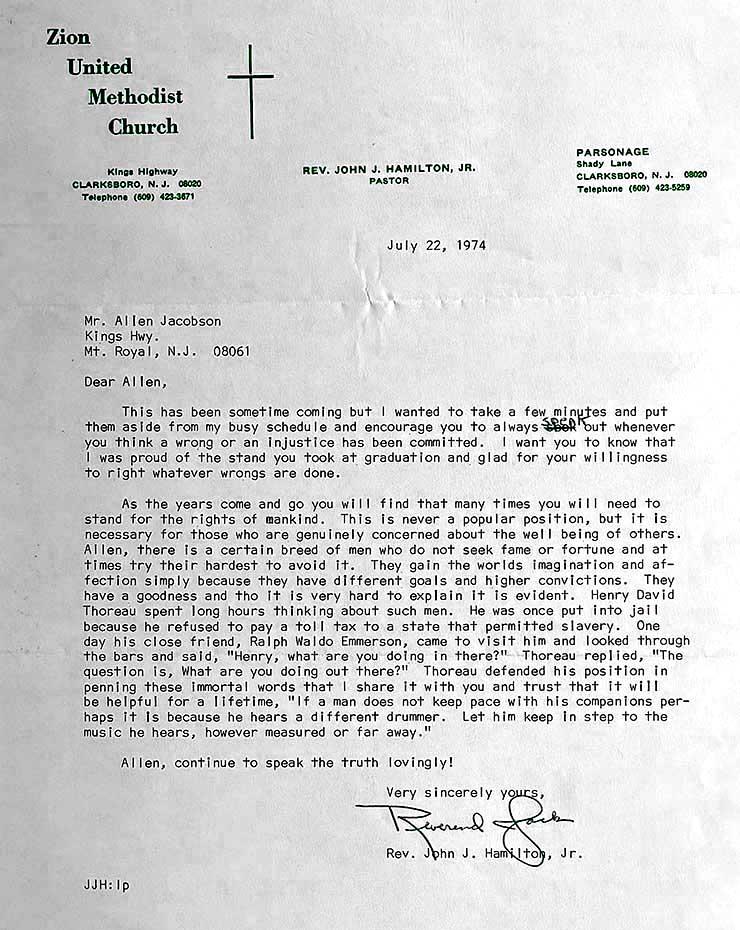
On July 23, 1846, Henry David Thoreau spent the night in jail for failing to pay a tax, as an act of protest against the Mexican-American War and the institution of slavery. According to the oft-told story, Ralph Waldo Emerson visited Thoreau in jail and asked why he was there.
Thoreau purportedly responded. “Why are you not here?”
I think about that exchange a lot. I am not asking you to sit in a jail cell with me. I am asking you not to walk past without looking in.
So here is the ask:
Give me 30 minutes. Like I said, I can be in Portland tomorrow.
Thirty minutes where I walk you through the architecture at a high level and the FairShareLicensing model in plain language, and you ask every hostile question you can think of. Thirty minutes where you decide, for yourself, whether this is worth understanding and whether there is any role – public or quiet, large or small – that you are willing to play.
If you come out of that 30 minutes unconvinced, I will stop asking.
If, on the other hand, you see what I see, then we can talk about what you are actually willing to put your name on.
Sandy, I’m not crazy. I’m just early. And I have been early before – when I predicted the decimation of newspapers in 2006 – long before it came to pass years later. And I paid a price for that prediction, as others before me paid a price when they were called crazy, but were merely early.
So, do I have the money in the bank?
No.
Do I have cash in hand?
Not yet.
Is this a lead pipe cinch?
Nope.
Might I fail?
Absolutely.
Are you under any obligation to do anything now?
No.
Do you have any reason to wait and see?
I cannot answer that for you.
Here is the only thing I know for sure:
On my gravestone, there will only be two words. “He tried.”
Because I’ve been Speaking Truth to Power Since ’74™
So, c'mon…it'll be fun!