
AI needs guardrails — just like capitalism did
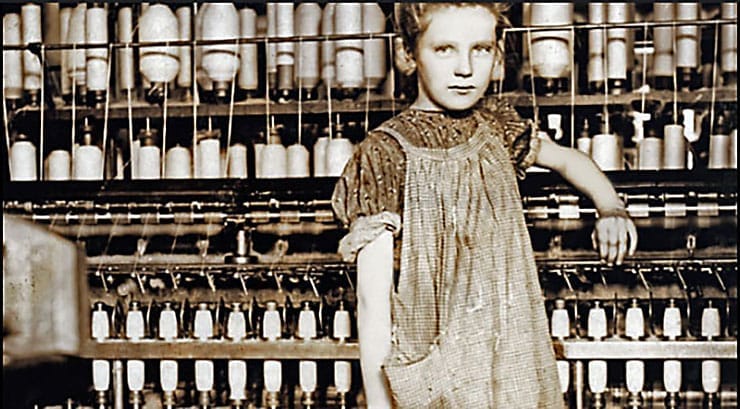
When people say “AI is dangerous,” they’re not wrong. But they’re missing the bigger truth.
AI without guardrails is a shit show.
So was unregulated capitalism.
The First Machine Revolution
The story starts in 18th-century England when spinning frames and steam engines began to outproduce human hands. It was dazzling. Factories multiplied. Productivity soared. The modern economy was born.
And so was misery.
By 1833, British factories employed more than 50,000 children under the age of 13. Many started as young as six. They worked twelve-hour days in airless rooms, cleaning under moving machinery that could tear off a hand in an instant. One factory inspector described a child who “had not time to go to the water closet and was compelled to ease herself in the waste.”
This was capitalism without rules.
Progress without conscience.
We celebrate the Industrial Revolution for lifting millions out of poverty — and that’s true — but it also created a new kind of poverty: industrial poverty, where the poor could no longer grow food or fix things or live by craft. They became replaceable parts in someone else’s machine.
The Slow Rise of Guardrails
The first real guardrails came from the British Parliament under pressure from activists and journalists — the “muckrakers” of their day. The Factory Act of 1833 limited children under nine from working in textile mills and capped the hours of those under thirteen to 48 per week. It wasn’t humane by modern standards but it was revolutionary then: the first admission that markets needed moral boundaries.
Over the next century every major economy followed suit.
In the United States Upton Sinclair’s The Jungle (1906) shocked the public with descriptions of meatpacking plants where rats, filth and fingers ended up in the same grinder. The outrage led to the Pure Food and Drug Act and the Meat Inspection Act, both signed by President Theodore Roosevelt that same year.
Roosevelt wasn’t anti-capitalist. He was a capitalist who understood its fragility.
His “Square Deal” promised fairness for workers, consumers and business alike. He broke up the Northern Securities Company — a railroad monopoly controlled by J.P. Morgan — and earned the nickname “trust buster.”
He once said, “The object of government is the welfare of the people. The material progress and prosperity of a nation are desirable chiefly so long as they lead to the moral and material welfare of all good citizens.”
That was the heart of the Progressive Era — a coalition of reformers, journalists and ordinary citizens who refused to accept that progress required cruelty. They fought for antitrust laws, workplace safety and child labor reform.
The first federal attempt to ban child labor came in 1916 with the Keating-Owen Act, signed by Woodrow Wilson, prohibiting goods made by children from crossing state lines. The Supreme Court struck it down two years later — but the moral tide had turned. By the 1930s the Fair Labor Standards Act (1938) made child labor illegal nationwide and created the 40-hour work week.
The Result: Prosperity With Protection
It’s easy to forget how radical that was. For a hundred years “regulation” had been a dirty word — something business called “interference.” But when those guardrails went up, capitalism didn’t collapse. It soared.
Once people trusted the system — once they knew they wouldn’t be poisoned by their food, crushed in their factory or starved by a monopoly — they participated. They built. They spent.
That trust became the engine of modern prosperity.
Capitalism with rules outperformed capitalism without them.
Europe’s aristocratic economies couldn’t match the dynamism of a society where anyone could rise — because in America the rules were built to protect participation, not privilege.
The Second Machine Revolution
Now we stand at the same crossroads with AI. The technology is dazzling — maybe even more so than steam or electricity. It can draft laws, design drugs and write poetry before you finish your coffee.
But look closer and you can already see the soot:
- Disinformation spreading faster than truth.
- Bias baked into algorithms that decide who gets a loan or a job.
- Deepfakes that blur reality beyond recognition.
- Creative work stolen and resold without consent or credit.
That’s AI without guardrails. It’s the digital version of 19th-century factories — astonishingly productive but indifferent to the human lives caught in its gears.
We’ve been here before.
The first industrialists said, “You can’t regulate progress.”
The first AI founders say the same thing now.
The Case for Ethical Infrastructure
Guardrails aren’t censorship. They’re engineering.
They’re what turns raw invention into sustainable civilization.
In capitalism those guardrails were labor laws, antitrust, transparency and taxation.
In AI they’ll be provenance, consent, compliance and accountability — the ability to trace what a model knows, who it learned from and how it profits from that knowledge.
Unchecked AI will consume trust the way unchecked capitalism consumed children.
But AI with ethical infrastructure can become the most empowering force since the printing press — one that extends human creativity instead of exploiting it.
When we built rules for capitalism, we didn’t stop innovation; we saved it from itself.
We made it human.
Now it’s time to do the same for AI.
Because if history teaches us anything, it’s this:
Progress without guardrails isn’t progress.
It’s just power looking for victims.
My name is Alan Jacobson. I'm a web developer, UI designer and AI systems architect. I have 13 patents pending before the United States Patent and Trademark Office—each designed to prevent the kinds of tragedy you can read about here.
I want to license my AI systems architecture to the major LLM platforms—ChatGPT, Gemini, Claude, Llama, Co‑Pilot, Apple Intelligence—at companies like Apple, Microsoft, Google, Amazon and Facebook.
Collectively, those companies are worth $15.3 trillion. That’s trillion, with a T—twice the annual budget of the government of the United States. What I’m talking about is a rounding error to them.
With those funds, I intend to stand up 1,400 local news operations across the United States to restore public safety and trust. You can reach me here.