
Advertising won’t save AI
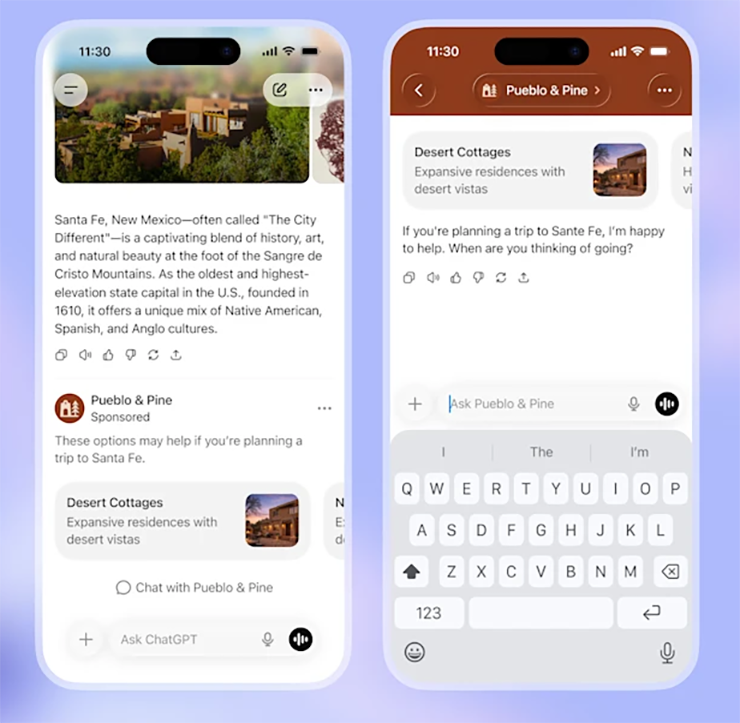
OpenAI’s prototype ads look harmless enough. They sit politely near answers. They look like ads – sort of. They promise relevance without surveillance. Nothing screams “feed takeover.”
That’s the problem.
They don’t look like they’ll make any money—because they won’t.
This isn’t a moral argument about ads. It’s an economic one. Advertising worked for search and social media because their cost structures, targeting mechanics, and content adjacencies aligned perfectly. Large language models break every one of those assumptions.
The cost problem no one can wish away
Every ChatGPT response costs OpenAI real money. Chips. Power. Cooling. Servers. Depreciation. Each answer has a meaningful marginal cost.
Google and Facebook don’t have that problem. Showing another search results page or another feed refresh costs them next to nothing. Pages are static. Ads are precomputed. Infrastructure is amortized. Scale makes it cheaper.
AI works in the opposite direction. More use means more cost.
Advertising only thrives where marginal cost approaches zero. LLMs never get there.
Why targeting collapses for AI
Advertising depends on precision.
Facebook works because users tell it everything—who they are, who they know, what they like. Google works because users reveal intent directly with queries like “best hot sauce” or “Tahoe cabin rental.”
OpenAI is explicitly saying it will not sell or use your private conversations to target ads. Answers can’t be influenced by sponsors. Sensitive categories are excluded.
Now ask the obvious questions.
If you ask ChatGPT whether your boyfriend is cheating on you, based on a, b, and c, what ad is supposed to appear to recover the cost of that answer?
A mattress? Therapy? A dating app?
If you ask ChatGPT to write an essay on the Spanish Inquisition—and nobody expects the Spanish Inquisition—what ad fits? A crucifix?
This isn’t a joke. It’s the core flaw.
The tasks ChatGPT is best at—thinking, writing, advising, synthesizing—are personal, abstract, emotional, or intellectual. They don’t map cleanly to products. And many of the few categories that might map are exactly the ones OpenAI says ads won’t touch.
Adjacency worked for hamburgers. Not for thinking.
Google can recommend a hamburger recipe for almost nothing. That’s why it can charge almost nothing to a hot sauce maker.
ChatGPT can do far more than recommend a hamburger. That’s why people use it for higher-level tasks. But those tasks are vastly more expensive to compute and vastly harder to monetize with ads.
Another example: you ask ChatGPT to write an email. What can it sell at the same time?
Maybe the email mentions a vacation to Tahoe. More often it’s a note to Aunt Betty, a complaint to Comcast, or a sensitive work message. There’s nothing to sell next to that without breaking trust.
Netflix already ran the experiment—for everyone
If you want a real-world benchmark for “ads plus pay to remove ads,” look at Netflix.
Netflix introduced advertising on a lower-priced tier in late 2022. It has everything advertisers want: massive reach, predictable inventory, passive consumption, and extremely low marginal delivery cost.
After years of ramp, projected U.S. ad revenue in 2026 is about $3.26 billion.
That’s in the richest ad market on Earth, on a product far better suited to ads than AI.
Netflix proves a hard truth: even at enormous scale, advertising adds a thin layer of revenue. It does not become the foundation.
If ads can’t meaningfully subsidize Netflix, they won’t subsidize large language models, which are more expensive to run and harder to monetize.
What OpenAI is really doing with pricing
OpenAI’s tiering tells the real story:
- Free and $8/month “Go” tiers: ads
- $20/month and above: no ads
That’s not confidence in advertising. That’s containment.
Ads are there to subsidize free users and push people up the ladder. Subscriptions are the real business model.
And even that model doesn’t solve the math.
There’s already a separate analysis showing that even if every man, woman, and child in the United States paid $20/month—250% more than the $8 tier—OpenAI only breaks even at 100% penetration. No profit. No cushion. Just survival.
Advertising doesn’t change that equation in any meaningful way. At best, it trims losses at the margins.
The unavoidable conclusion
OpenAI’s ad mockups look innocuous because they have to be. The moment ads become aggressive, targeted, or persuasive, the product breaks. Trust evaporates. The value proposition collapses.
So ads are limited. Optional. Segregated. Removable for a small fee. And structurally incapable of paying for what AI actually costs.
That’s not a failure of execution. It’s a consequence of physics and economics.
Advertising won’t save AI.
AI will have to be paid for directly—or governed so tightly that it runs far less often. Everything else is a rounding error attached to a compute business.
– Published Sunday, January 25, 2026